

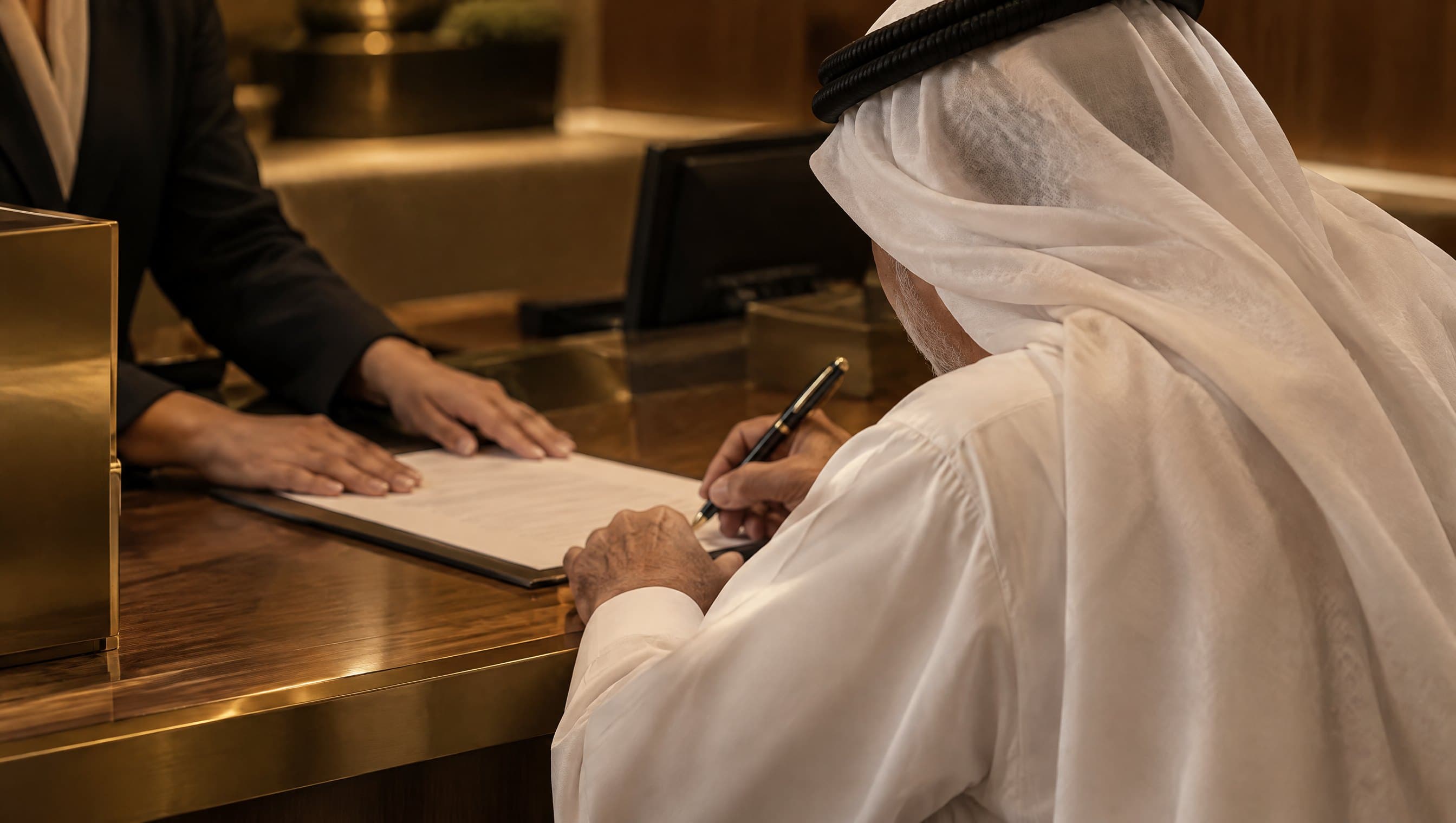
Corporate & Commercial9 min read
General power of attorney in Qatar: the risks and how to limit them

Faysel Al-MohannadiLawyer admitted before the Court of Cassation · Reviewed on
Short answer
A general power of attorney in Qatar can give an agent wide powers. Vague wording covers only administration, but the agent can sell or mortgage once the POA names those acts, even without naming the property. Read the powers first, prefer a special POA with an end date, and know you can usually revoke it at the Ministry of Justice.
What is the difference between a general and a special power of attorney?
A power of attorney (agency) is a contract under which the agent carries out a legal act on behalf of the principal (Civil Code Article 716). Any contract the agent makes in your name and within their authority binds you directly, as if you had signed it yourself (Article 84).
The Ministry of Justice's Documentation Department offers two main types. It describes the "General Power of Attorney" as covering a wide range of legal acts, including administration, dispositions and representation before various bodies. A "Special Power of Attorney" covers a specific act, with versions for real estate, a vehicle, a company, a bank or shares, among others.
| Point | General POA | Special POA |
|---|---|---|
| Scope | Wide powers over your assets and affairs, as written in it | One specific act or one type of act |
| Sale, mortgage, gift | Valid if the POA names them | Valid only within what it states |
| Level of risk | Higher: the agent can deal with many assets without asking you | Lower: the authority is contained |
| Typical use | Managing affairs during a long absence, through a fully trusted agent | One deal, transaction or case |
Can an agent with a general POA sell your property?
It depends on the wording, not the document's name. A POA in general terms, without even naming the type of act, covers only acts of administration, such as leases of up to three years, upkeep, collecting what you are owed and paying your debts (Article 719).
Sale, gift, settlement, mortgage, admissions, arbitration and court proceedings need a special authority (Article 721(1)). However, a special authority for a type of act is valid even if it does not name the specific asset, except for gifts (Article 721(2)). So if your POA says "buying and selling real estate", the agent can sell any property you own without that property being named.
A notary checks that a document signed by an agent stays within the POA and must refuse it if not (Notarisation Law No. 1 of 2023, Articles 9 and 10). The real estate registration office also checks the agent's powers (Law No. 5 of 2024, Article 20). But these checks read your POA, not your intentions. If the text allows a sale, the sale goes through.
What are the risks of a general POA?
The core risk is that what the agent does within the POA binds you. Common problems include:
- A sale, mortgage or gift of an asset under powers the principal did not notice when signing.
- The agent contracting with themselves, for example buying your property. This is not allowed without your permission, and otherwise does not bind you unless you ratify it (Article 88). Watch for any clause that gives that permission.
- Delegation to a stranger. An agent who delegates without authority is jointly liable for the substitute's acts (Article 728), but that does not always recover what was lost.
- The agent using your money for themselves. This is prohibited and gives you a claim for compensation (Article 725), and squandering money handed over under an agency can be breach of trust, a crime (Penal Code Article 362).
- A POA that stays in force for years after you no longer need it, because it ends only when the task is done, its term expires, it is revoked or, with exceptions, one of the parties dies (Article 734).
- A POA given in the interest of the agent or a third party, which you cannot end or restrict without that person's consent (Article 735(2)).
Conversely, acts beyond the agent's authority do not bind you unless you ratify them (Article 87). The agent must keep you informed and give you an account supported by documents (Article 724).
How can you limit the scope and duration of a POA?
The protection that matters most is written into the POA before it is notarised, not after something goes wrong.
Choose a special POA whenever your need is specific, such as selling one property or following up a government transaction.
List the permitted acts precisely, identify the asset by number or description, and expressly exclude sale, mortgage and gift if you do not intend them.
State that the agent may not contract with themselves or appoint a substitute without your written permission.
Set an end date. A POA ends when its term expires (Article 734).
If you appoint more than one agent in a single POA and do not allow them to act alone, they must act together (Article 726(2)). Use this for major transactions.
Ask for regular accounts supported by documents (Article 724), and keep a copy of the POA.
A POA must take the form the law requires for the act it covers (Article 718), so if the law requires an official form for a transaction, the POA must be official too. You can apply for a POA through the Ministry of Justice's digital channels, including the SAK app, using your Hukoomi account. Powers of attorney for a lawyer in court cases are covered in our guide to choosing a lawyer.
How do you revoke a power of attorney?
A principal may end or restrict a POA at any time, even if they agreed otherwise (Article 735(1)). The exception is a POA given in the interest of the agent or a third party (Article 735(2)). You must compensate the agent if you dismiss them at an unsuitable time or without an acceptable reason (Article 735(3)).
Apply to the Ministry of Justice's Documentation Department for "Power of Attorney Revocation" («إلغاء توكيل»). This digital service lets the principal revoke or suspend the powers granted under an earlier notarised POA.
Attach your QID or passport, the commercial registration, establishment card and trade licence if the principal is a company, and a copy of the POA if you have one. The Ministry's hotline is 137.
Tell the agent in writing, and tell the people they deal with in your name, such as your bank, a developer or a business partner.
Ask the agent for a final account of what they did and for your documents back (Article 724).
This matters because someone who contracts with the agent after the POA has ended can still rely on the contract if neither of them knew it had ended and could not have known with ordinary care (Article 86).
A POA also ends when the agent dies and, with exceptions, when the principal dies. The heirs must notify the Documentation Department, which records the end of the POA (Civil Code Article 734; Notarisation Law Article 30). An agent may also step down (Article 736), and the Ministry has a service to notarise that. A POA issued before 2011 cannot be used for any transaction at the Documentation Department unless it has been entered in its electronic register of powers of attorney (Notarisation Law Article 33).
What about a power of attorney made outside Qatar?
A POA notarised before a foreign authority cannot be used in Qatar straight away. Documents issued abroad are normally attested by the issuing country's foreign ministry, then by the Qatari mission there, then approved in Qatar, as the Ministry of Foreign Affairs' attestation services explain. Also check:
- A certified Arabic translation of every foreign-language document linked to the transaction (Notarisation Law Article 7).
- An official form for the POA if the transaction in Qatar requires one (Civil Code Article 718).
- Clearly written powers, because a notary refuses anything beyond the POA (Notarisation Law Articles 9 and 10).
The Documentation Department also has a service for accepting, depositing and recording documents notarised before foreign authorities (Notarisation Law Article 16). Before you sign abroad, ask the body in Qatar that will receive the POA, such as your bank or the real estate registry, which wording and attestations it accepts.
When should you speak to a lawyer?
Not every POA needs a lawyer, but advice helps before a POA over significant assets, or once a problem appears. Signs it is worth asking:
- You have been asked to sign a general POA, or a POA in the agent's interest, as part of a property or business deal.
- The POA allows sale, mortgage, self-dealing or delegation, and you are unsure what that means.
- You want to revoke a POA and the agent will not give an account or return your documents.
- You have found a transaction you did not authorise, or one made after the POA was revoked.
- You will sign a POA abroad for use in Qatar, or you have received a foreign POA to act on.
- The principal or the agent has died and transactions are unfinished.
What the law says
This guide relies on the Civil Code issued by Law No. 22 of 2004, in particular Articles 84, 86 to 88 and 716 to 736; the Notarisation Law, Law No. 1 of 2023 (Articles 7, 9, 10, 16, 30 and 33); Article 20 of Law No. 5 of 2024 on real estate registration; and Article 362 of the Penal Code. It also draws on the Ministry of Justice's notarisation service pages and the Ministry of Foreign Affairs' attestation pages, as shown on 18 October 2026.
Read on Al MeezanQuestions people ask
As a rule, yes, unless it was given in the interest of the agent or a third party, or was meant to continue after death (Article 734). The heirs must notify the Documentation Department so it can record the end of the POA (Notarisation Law Article 30).
Generally not: the principal may end a POA at any time (Article 735). A POA given in the interest of the agent or a third party cannot be revoked without that person's consent, and you may owe compensation if you revoke at an unsuitable time or without an acceptable reason.
An agent may not contract in your name with themselves without your permission; otherwise the transaction does not bind you unless you ratify it (Article 88). Check that your POA does not give that permission.
Yes. A POA ends when its fixed term expires (Article 734), so write the end date into the document.
This guide is general information about Qatari law, not advice on your case.
Guides on this
All guides Corporate & CommercialRegistering a business in someone else's name in Qatar: the legal risksCommercial concealment means letting a non-Qatari run an unlicensed business using someone else's name, commercial registration or licence. Law No. 3 of 2023 punishes both sides with up to two years in prison and a fine of up to QAR 500,000, or either, plus possible confiscation and deportation. The legal alternative is open ownership under Law No. 1 of 2019.
9 min read
 Corporate & CommercialEnforcing a foreign court judgment in QatarThe Enforcement Court can order a foreign judgment enforced in Qatar under Article 13 of Judicial Enforcement Law No. 4 of 2024. It requires reciprocity, a final judgment from a competent court, proper notice, and no conflict with a Qatari judgment or public order. The GCC Convention takes priority, and arbitral awards follow the Arbitration Law and New York Convention.
8 min read
 Corporate & CommercialBefore you sign a contract in Qatar: the clauses to checkBefore signing a contract in Qatar, check who the other party is and who may sign for it, the scope, payment and security, any penalty clause, termination rights, the governing law and forum or arbitration, the prevailing language, and whether notarisation or registration is required. Civil Code Law No. 22 of 2004 lets a judge reduce an excessive penalty.
8 min read
Before you sign or revoke a power of attorney
Understand the powers it gives and how they affect you, and ask about your situation.