


Guides8 min read
How to choose a lawyer in Qatar

Faysel Al-MohannadiLawyer admitted before the Court of Cassation · Reviewed on
Short answer
Start by checking that the lawyer is on the Ministry of Justice's register of lawyers and that their admission level fits your court. At the first meeting, ask who will actually handle your matter, what the plan is and how you will be kept informed. Agree the fee in writing, and expect a notarised power of attorney.
How do you check that a lawyer is licensed?
Check that the lawyer's name appears on the register of lawyers («جدول المحامين المقيدين») that the Ministry of Justice publishes on its Lawyer Services page. Only registered lawyers may practise law, which includes appearing before the courts and the Public Prosecution, giving legal advice and drafting contracts (Article 3). Practising without being a lawyer is an offence (Article 77).
Open the Lawyer Services page on moj.gov.qa and choose "Register of Registered Lawyers".
Search for the lawyer's full name. The list shows each lawyer's registration number and admission level.
Compare the registration number with the one the lawyer gives you.
Check the list's date. It is a snapshot, and lawyers must renew their registration before 1 January each year (Article 26).
If the name is missing, ask the lawyer why, or contact the Ministry's Lawyers Affairs Department.
The admission level decides which courts a lawyer may argue before (Article 12):
| Roll | What it allows | Article |
|---|---|---|
| Trainee | Cannot argue cases in their own name or sign claims and briefs. After one year, may argue before the Court of First Instance on the supervising lawyer's behalf | 23 |
| Court of First Instance | Appearing and arguing before the Court of First Instance | 14 |
| Court of Appeal | Appearing and arguing before all courts except the Court of Cassation. Needs at least five years on the first instance roll | 15 |
| Court of Cassation | The highest level. Needs ten years in practice, at least three on the appeal roll, or equivalent judicial or legal experience | 16 |
A non-Qatari lawyer at a Qatari firm may be licensed to appear in the firm's name, and is kept on a separate Ministry register (Article 9; Lawyers Admission Committee Decision No. 117 of 2026). If so, ask which Qatari lawyer is responsible for your file.
What should you ask at the first meeting?
At the first meeting, ask questions that show the lawyer's experience with your type of matter, who will work on it and what lies ahead. Write the answers down so you can decide calmly.
- Have you handled matters like this, and before which court or authority?
- Who will actually handle my file and attend hearings? A lawyer may send another lawyer in their place, under their own responsibility, unless the power of attorney forbids it (Article 32).
- What is your first view of my position, what steps do you expect, and which documents and deadlines matter?
- Are there alternatives, such as a settlement?
- How often will you update me, and whom do I contact when you are away?
- What is the fee, what does it cover, and who pays court fees and expenses?
How are lawyers' fees set in Qatar?
A lawyer's fee is set by agreement between lawyer and client (Article 37). It is safest to put the agreement in writing and describe the work precisely. This guide gives no prices, because fees vary from matter to matter.
Law No. 19 of 2025 amended Article 37. The parties may now agree a fee of no more than 25% of the amount the court awards. The cap had been 10% since 2018, and the original 2006 text did not allow fees to be tied to the amount awarded.
| What the law says | Why it matters | Article |
|---|---|---|
| If the fee is not set in a written agreement, either side can ask the court to assess it | Writing avoids a dispute over the amount | 40 |
| The lawyer may recover case expenses, and charge for related cases not foreseen when you agreed | Ask what the fee covers and what it does not | 36 |
| The full fee falls due only once the judgment is enforced, unless you agree otherwise | Set payment dates in the agreement | 38 |
| Dismissing the lawyer without good reason before the work is done makes the full fee due | Read the termination clause before you sign | 39 |
If you cannot afford a lawyer, the Judicial Assistance Committee at the Court of First Instance may appoint one in cases the law sets out, for example where the claim is likely to succeed (Article 61).
What do confidentiality and conflicts of interest mean for you?
What you tell your lawyer is confidential by law. The lawyer must protect your information and documents (Article 51), and may not disclose what they learned through their work, even after the engagement ends, except to prevent or report a felony or misdemeanour. They may not testify against you in a matter you hired or consulted them on (Article 57).
A lawyer may not act for, or advise, your opponent in the same dispute, or in any other dispute while yours is pending, and may never represent conflicting interests. The ban covers everyone in the same office (Article 49). Give the lawyer the names of the other parties at the start so they can check.
What should you receive when you hire a lawyer?
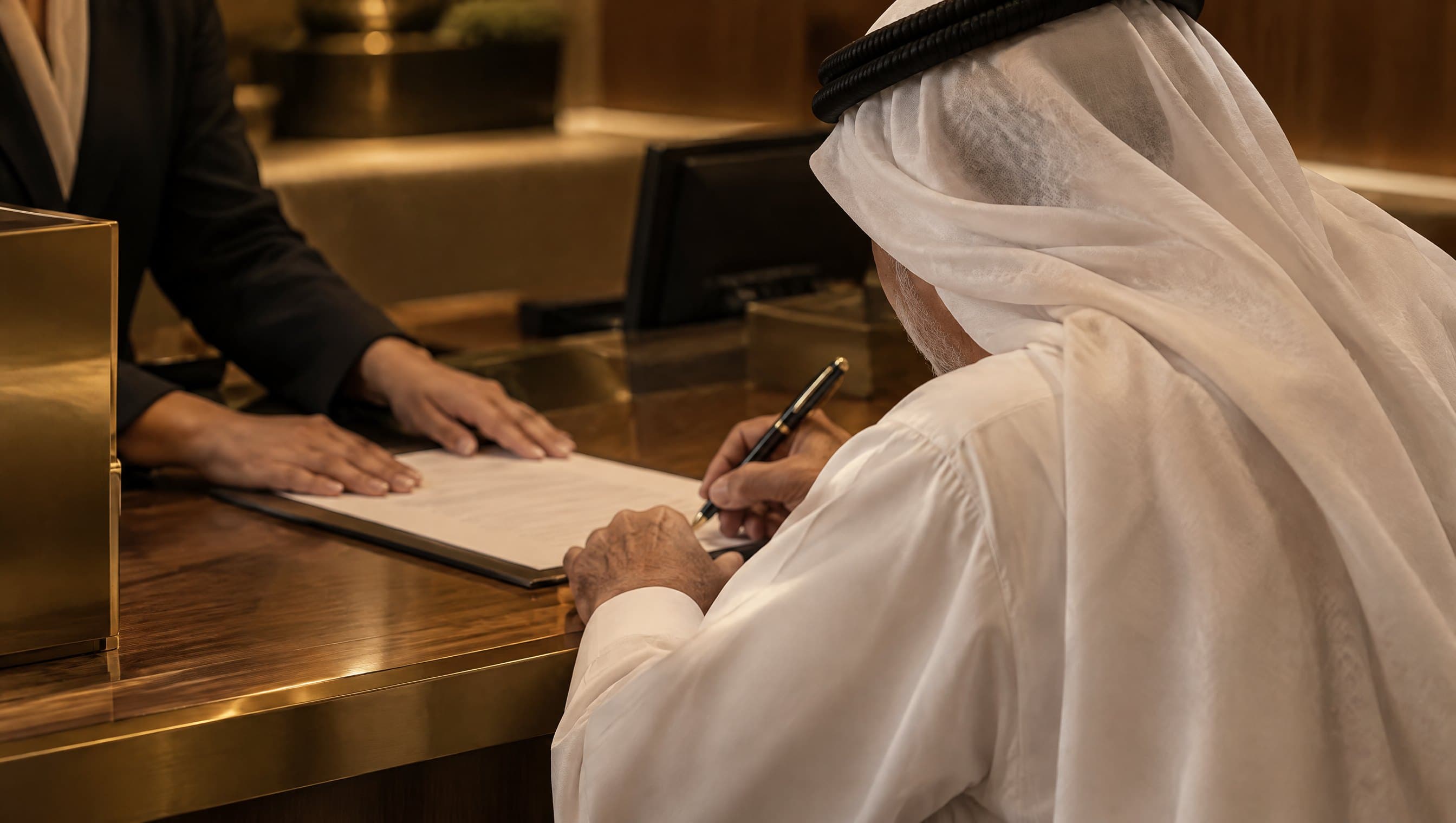
Expect a written fee agreement and a notarised power of attorney (توكيل). A lawyer appears for a client under a power of attorney notarised in accordance with the law (Article 54).
- A written fee agreement covering the work, the fee and payment, expenses, and what happens if the relationship ends. For services provided online, Decision No. 118 of 2026 requires a contract setting out both sides' duties and rights (Article 2).
- A power of attorney notarised by the Ministry of Justice's Documentation Department, either a "General Power of Attorney for Cases" or a "Special Power of Attorney for One Case".
- Copies of what is filed in your name, and a receipt for any original document you hand over.
Bring your QID or passport, plus the commercial registration if the client is a company and a case summary for a single-case power of attorney.
Apply through the Ministry's digital channels, including the SAK app and sak.gov.qa, with your Hukoomi account. The Ministry's hotline is 137.
Read the scope before approving it: general or one case, and whether it prevents delegation to another lawyer.
You can later revoke the power of attorney through the Ministry's revocation service. When the engagement ends, the lawyer must return it and your documents, unless they were filed in the case (Article 59).
What are the warning signs?
These signs do not always mean bad faith, but each is worth a question before you sign:
- A promise of a certain result. Judgments rest with the court, and a lawyer's promotional content must not mislead the public (Decision No. 118 of 2026, Article 2).
- Pressure to sign or pay at once, with no time to read the documents.
- No written fee agreement, or vagueness about what it covers.
- A name missing from the register, or no clear answer on who will handle your file.
- A wider power of attorney than your matter needs, without explanation.
- Someone who is not a lawyer offering to "take care of" your case, or asking a commission to introduce you to one.
Complaints about a lawyer go to the Ministry's Lawyers Affairs Department, which asks for proof of the relationship, such as the power of attorney or fee agreement. The right to complain lapses six months after the client learns all the facts (Article 60).
When is it worth speaking to a lawyer at all?
Not every legal question needs a lawyer. Advice usually helps when something formal has started, a deadline is close, or something important is at stake. Our “Do I need a lawyer?” check helps you judge your situation in about a minute. Typical signs:
- You received a summons, notice or call from an official body.
- A case or complaint has been filed against you, or there is a judgment you want to understand.
- There is a deadline within days.
- Your job, residency, children or money could be affected.
- You have been asked to sign a contract or settlement and are unsure what it means.
This guide was prepared by Al Faisal Law Firm & Legal Consultations in Doha. If you would like to ask us about your situation, apply the same checks to us.
What the law says
This guide relies on the Advocacy Law issued by Law No. 23 of 2006, as amended most recently by Law No. 19 of 2025, which changed the fee rule in Article 37. It draws especially on Articles 3, 6, 8, 9, 12, 14 to 16, 23, 26, 32, 36 to 40, 49, 51, 54, 57 and 59 to 61, and on Lawyers Admission Committee Decisions No. 117 and No. 118 of 2026. Texts checked on Al Meezan on 18 October 2026.
Read on Al MeezanQuestions people ask
An individual may ask a spouse, or a relative or in-law up to the fourth degree, to appear for them, except before the Court of Cassation (Article 6). An appeal to the Court of Appeal or the Court of Cassation still needs a power of attorney for a lawyer admitted before that court.
The Lawyers Admission Committee may license a non-Qatari lawyer working at a Qatari firm to appear in the firm's name (Article 9). The Minister may also allow a foreign lawyer to argue a specific case alongside a lawyer practising in Qatar (Article 8).
Raise it with them first and ask for a written explanation. You can complain to the Ministry's Lawyers Affairs Department within six months of learning the facts (Article 60), and you can end the engagement, bearing in mind the effect on fees (Article 39).
This guide is general information about Qatari law, not advice on your case.
Guides on this
All guides GuidesRegistering a business in someone else's name in Qatar: the legal risksCommercial concealment means letting a non-Qatari run an unlicensed business using someone else's name, commercial registration or licence. Law No. 3 of 2023 punishes both sides with up to two years in prison and a fine of up to QAR 500,000, or either, plus possible confiscation and deportation. The legal alternative is open ownership under Law No. 1 of 2019.
9 min read
 GuidesEnforcing a foreign court judgment in QatarThe Enforcement Court can order a foreign judgment enforced in Qatar under Article 13 of Judicial Enforcement Law No. 4 of 2024. It requires reciprocity, a final judgment from a competent court, proper notice, and no conflict with a Qatari judgment or public order. The GCC Convention takes priority, and arbitral awards follow the Arbitration Law and New York Convention.
8 min read
 GuidesGeneral power of attorney in Qatar: the risks and how to limit themA general power of attorney in Qatar can give an agent wide powers. Vague wording covers only administration, but the agent can sell or mortgage once the POA names those acts, even without naming the property. Read the powers first, prefer a special POA with an end date, and know you can usually revoke it at the Ministry of Justice.
9 min read
Ask about your situation
If you have a legal question and want to understand where you stand before you decide, you can ask us.